Version Number: v1.0.1
Published Date: 29 Sep 2026
____________________________________________________________________________
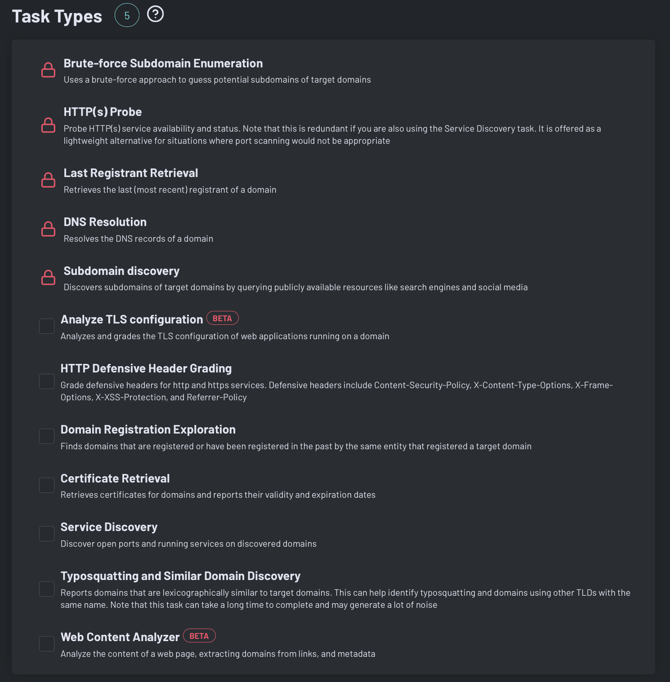
The Investigations page provides a detailed breakdown of tasks involved in the investigation, categorised as either "Required" or "Optional":
Investigation settings marked as required are mandatory as part of any investigation.
| Task | Task Description | Requirements |
| Brute-force Subdomain Enumeration | Uses a brute-force approach to guess potential subdomains of target domains | Required |
| HTTP(s) Probe | Probe HTTP(s) service availability and status. Note that this is redundant if you are also using the Service Discovery task. It is offered as a lightweight alternative for situations where port scanning would not be appropriate | Required |
| Last Registrant Retrieval | Retrieves the last (most recent) registrant of a domain | Required |
| DNS Resolution | Resolves the DNS records of a domain | Required |
| Subdomain discovery | Discovers subdomains of target domains by querying publicly available resources like search engines and social media | Required |
| Analyze TLS configuration | Analyzes and grades the TLS configuration of web applications running on a domain | Optional |
| HTTP Defensive Header Grading | Grade defensive headers for http and https services. Defensive headers include Content-Security-Policy, X-Content-Type-Options, X-Frame-Options, X-XSS-Protection, and Referrer-Policy | Optional |
| Domain Registration Exploration | Finds domains that are registered or have been registered in the past by the same entity that registered a target domain | Optional |
| Certificate Retrieval | Retrieves certificates for domains and reports their validity and expiration dates | Optional |
| Service Discovery | Discover open ports and running services on discovered domains | Optional |
| Typosquatting and Similar Domain Discovery | Reports domains that are lexicographically similar to target domains. This can help identify typosquatting and domains using other TLDs with the same name. Note that this task can take a long time to complete and may generate a lot of noise | Optional |
| Web Content Analyzer | Analyze the content of a web page, extracting domains from links, and metadata | Optional |
Task Types Platform Selection